
Clay County Court Records After Arrest
An arrest in Clay County creates a jail booking record first. The Clay County Jail roster may show the arresting agency, charge text, charge class, warrant number, booking time, bond row, and days in jail. That booking record is useful, but it is not the final court record. The court file starts or changes when a prosecutor files a charging document or when an existing case produces a warrant, motion to revoke, or other order.
The sheriff's open-records form makes the split clear: the Clay County Sheriff's Office does not have court records and tells requesters to contact the court of jurisdiction. Sheriff Sidney "Kirk" Horton and the sheriff's office operate the jail and roster. Court records after a Clay County arrest are handled through the proper clerk or court, with felony district-court records routed to the Clay County District Clerk and county-level prosecution routed through the County Attorney when that office is involved.
Clay County Jail is the only detention facility resolved in the official facility map. Current local custody is checked through that jail roster and the sheriff Records Division. Once a person is sentenced and transferred, use TDCJ for state-prison custody, BOP for federal custody, ICE for immigration detention, and VINELink for custody notifications where available. No official Clay County, Texas sheriff or city-police mobile app with inmate, warrant, or records-request tools was located during research.
For booking details, custody status, and jail face sheets, the Clay County jail inmate records route is the right starting point. For booking photos, the Clay County jail mugshots page covers the roster photo setting and records-request path. Court records after a jail arrest are narrower: they answer what charge was filed, which court is handling it, and what happened next.
Clay County District Court Records
Felony and district-court records are routed through the Clay County District Clerk. The official page names Marianne Bowles as District Clerk, lists the Clay County Courthouse at 100 North Bridge Street in Henrietta, and says the office serves as clerk and custodian of records for the district courts. The same page links court records and online payment information for felony criminal court costs, which also signals why a case number matters once charges are filed.
The District Clerk's public counter is listed as Monday through Thursday from 8:00 AM to noon and 1:00 PM to 4:00 PM, and Friday from 8:00 AM to 4:00 PM. Use the clerk for district felony case records, copies, certified copies, expunction filings, and nondisclosure filings when the case belongs in that court. Do not use the sheriff's jail form to request a filed indictment, judgment, docket sheet, or court order.
The Clay County District Clerk page is the source shown below.
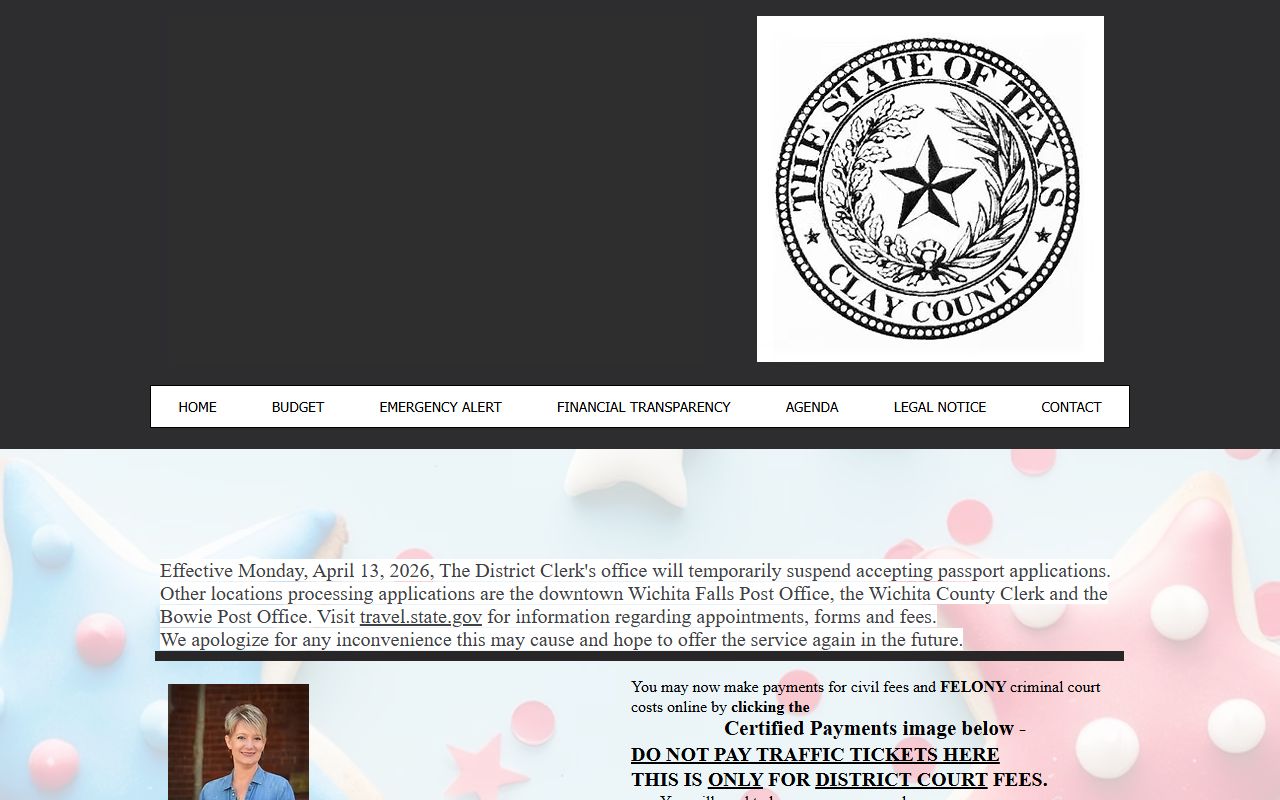
The District Clerk route matters most when a jail arrest becomes a felony court record in the 97th District Court structure.
Find Court Records After Clay County Arrest
The District Clerk links the Texas court-record search portal as an official search path. Research could not fetch the live form fields because the portal blocked the automated request, so the safest use is to treat it as an official statewide case-search doorway and avoid claiming a field label that was not confirmed. Search by the defendant name, case number if known, and Clay County or the relevant court when those filters are available.
- Start with the jail roster if the arrest is recent. Pull the name spelling, booking date, arresting agency, charge text, warrant number, and bond row.
- Open the District Clerk page or the statewide court-record search portal linked by that office.
- Search by defendant name first. Add Clay County, the 97th District Court, or the case number when the portal offers those choices.
- Compare the filed charge to the jail charge. A booking charge can be amended, reduced, dismissed, or replaced.
- If no online case appears, contact the District Clerk, the County Attorney, or the court named on the arrest, bond, or warrant paperwork.
The Texas court-record search portal is shown here through the manifest image sourced from the District Clerk's court-record link.

The portal can help with indexed court records, but the county clerk or court remains the fallback when a case is too new, sealed, or not exposed online.
| Search Item | Use | Clay County Note |
|---|---|---|
| Defendant name | Find a filed criminal case by party. | Use the spelling from the jail roster if the arrest is recent. |
| Case number | Open a known court file. | Required for some District Clerk payment functions. |
| County or court scope | Narrows statewide results. | Choose Clay County or the 97th District Court when shown. |
| Date or case type | Filters broad matches. | Use only if the portal exposes those filters. |
Clay County Arrest Charging Records
After a Clay County jail arrest, the filed court record may begin with a complaint, information, indictment, motion to revoke, or similar filing. A complaint is a sworn allegation. An information is filed by a prosecutor and is common in misdemeanor practice and some felony paths when allowed. An indictment is a grand-jury charging document used for felony prosecution. A motion to revoke is different from a new charge; it asks the court to act on an alleged violation of probation or community supervision.
The Clay County roster can show warrant and motion-to-revoke language before the final court record is easy to find. That is why court records after a jail arrest should be checked against the clerk file. The charge shown at booking can be a law-enforcement label, warrant caption, or preliminary allegation. The filed case is the better source for the exact charge, court level, current status, and next hearing once the clerk has opened or updated the file.
| Document | Who Uses It | What It Means |
|---|---|---|
| Complaint | Officer, affiant, or prosecutor | A sworn allegation that can start or support criminal proceedings. |
| Information | Prosecutor | A prosecutor-filed charge, often tied to misdemeanor prosecution and some felony routes. |
| Indictment | Grand jury | A grand-jury felony charging instrument that becomes part of the court file. |
Clay County Prosecutor Routing
Clay County's official prosecutor page located in the research is the Clay County Attorney page. It names County Attorney Seth C. Slagle, lists 111 S. Main Street in Henrietta, and provides a phone number for county attorney contact. Use that office for county-level and misdemeanor prosecution questions when the case belongs there. Felony district-court records still route through the District Clerk and district-court structure.
The Clay County Judge page adds useful local context because county judges in Texas counties often have misdemeanor criminal, small civil, probate, and related duties. It does not mean one office handles every arrest case. The court of jurisdiction depends on the charge level, the filing, and any warrant or motion tied to the arrest.
The official Clay County Attorney source appears below.
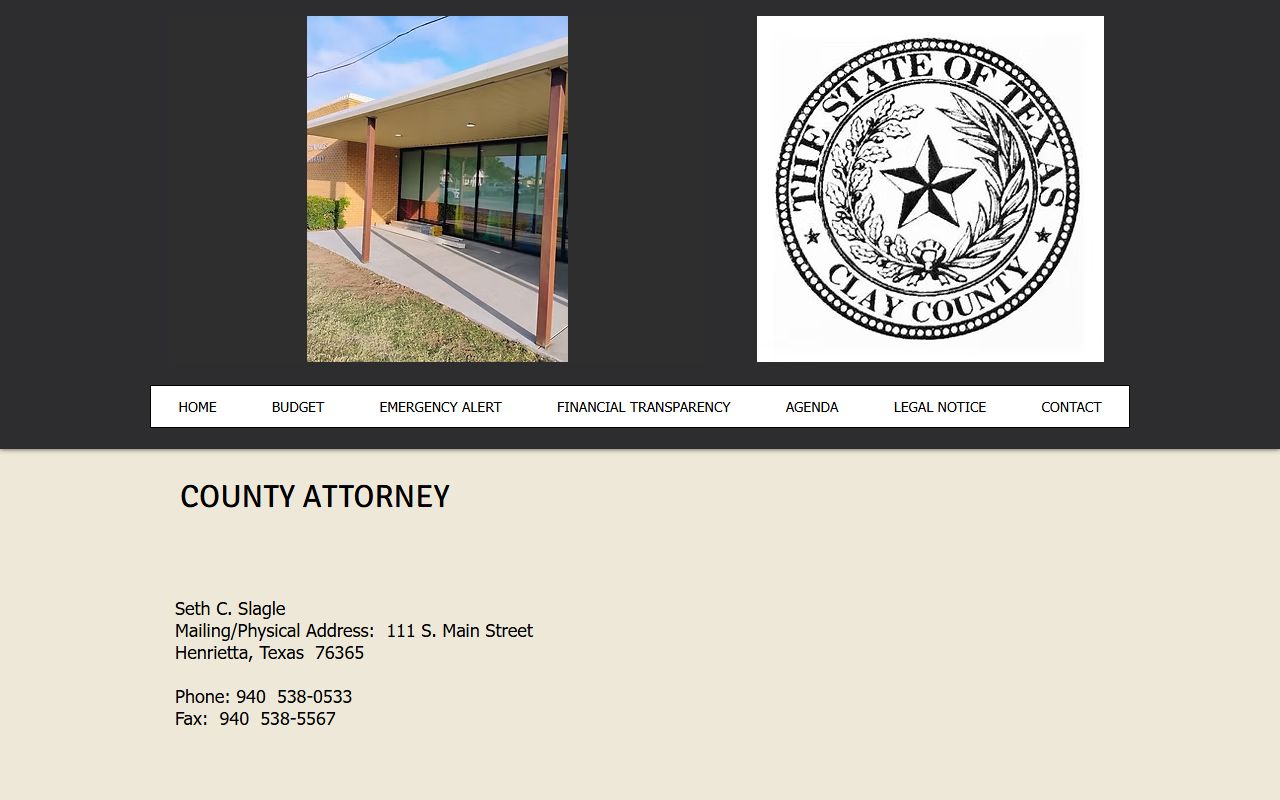
The prosecutor contact helps with routing, but copies of filed court records still come from the court clerk or court that maintains the file.
Clay County Arrest Charge Status
Charge status can change quickly after a jail arrest. A pending charge is unresolved. A filed charge means the prosecutor or court has opened a case. An amended charge has changed from an earlier version. A reduced charge is a lower charge or class. Dismissed means the case or charge is not proceeding in that court. Deferred adjudication or community supervision can have special consequences under Texas law, so it should not be treated as the same thing as a simple dismissal.
| Status | Plain Meaning | Where to Confirm |
|---|---|---|
| Pending | The filed charge has not reached final disposition. | Court record or clerk docket. |
| Amended or reduced | The charge changed after booking or filing. | Court record, prosecutor filing, or judgment. |
| Dismissed | The charge is not going forward in that case. | Dismissal order or docket entry. |
| Conviction | Guilt was found or admitted by plea. | Judgment, sentence, or clerk record. |
Bond Records After Clay County Arrest
Bond information starts in the jail record, but later bond orders can appear in court records after a Clay County arrest. Texas Code of Criminal Procedure Article 15.17 covers the magistrate-warning stage after arrest and generally requires the arrested person to be taken before a magistrate without unnecessary delay. Chapter 17 defines bail and governs release-security decisions.
Clay County official pages did not publish a jail bond counter, online jail bond payment portal, or accepted bond payment methods. The practical route is to call Clay County Sheriff's Office at (940) 538-5611 or contact the court of jurisdiction. District Clerk online payment information is for civil fees and felony criminal court costs through Certified Payments, not a blanket jail-release bond tool.
| Bond Type | How It Works | Clay County Caution |
|---|---|---|
| Cash bond | Money posted directly if accepted by the proper office. | Local bond-counter rules were not published in official sources. |
| Surety bond | A licensed bondsman posts a bond for a fee. | Check each charge row and court order. |
| Personal or PR bond | Release by promise to appear and follow conditions. | Must be authorized by the court or magistrate. |
| No-bond hold | Money may not secure release on that charge or hold. | A warrant, detainer, or motion to revoke can keep the person in custody. |
Clay County Warrants After Arrest
No official Clay County active-warrant search portal was located in the sheriff or county sources reviewed. Once someone is booked, the Kologik jail roster may show a warrant number, bench warrant language, motion-to-revoke language, arresting agency, bond amount, and days in jail. That post-arrest roster detail is not the same as a public pre-arrest warrant search.
Warrants may come from justice, municipal, county, district, out-of-county, state, or federal authority. A person with a possible active warrant should contact the issuing court or an attorney before appearing in person, especially when an arrest risk exists. The Clay County Sheriff's Office can be called at (940) 538-5611, and existing sheriff records can be requested through the Records Division when the requester has enough identifying detail.
Important: TDCJ, BOP, ICE, and VINELink are custody or notification tools, not general active-warrant search systems.
Charges vs Convictions
A Clay County arrest, booking charge, or filed charge is not a conviction. The roster may show what the person was arrested for or held on. The court record shows whether the charge was filed, changed, dismissed, deferred, pleaded, tried, or sentenced. Employers, landlords, insurers, and other regulated users should not treat casual public-record searches as consumer reports.
| Point | Charge | Conviction |
|---|---|---|
| Stage | An accusation or filed criminal count. | A final guilt finding or plea outcome. |
| Proof | May begin from probable cause or a charging paper. | Requires the legal standard for conviction or a valid plea. |
| Record source | Roster row, complaint, information, or indictment. | Judgment, sentence, or final court disposition. |
Sealed or Expunged Records
Texas uses expunction and nondisclosure concepts for eligible criminal records. Texas Code of Criminal Procedure Chapter 55A governs expunction. An expunction can clear qualifying arrest records by court order. Nondisclosure limits public access to eligible criminal-history information, but it is not the same as destroying every record.
The Clay County District Court fee schedule effective January 1, 2024 listed expunction at $350, nondisclosure at $350, automatic nondisclosure at $28, copy at $1, certified copy at $1 per page plus a $5 certification fee, electronic copy of an electronic document at $1, and bond approval at $5. Those are court-record fee examples, not sheriff jail-record fees.
| Record Action | Effect | Clay County Route |
|---|---|---|
| Nondisclosure | Limits public access for eligible criminal-history records. | District Clerk or court of jurisdiction when filing is required. |
| Expunction | Clears eligible arrest records by court order. | District Clerk filing route for qualifying court cases. |
| Redaction or withholding | Removes confidential portions from a release. | Sheriff Records Division or clerk applies Texas access law. |
Public Access Limits
Texas Government Code Chapter 552, the Public Information Act, is the basic access framework for Clay County sheriff and county records. Section 552.108 allows certain law-enforcement, corrections, and prosecution information to be withheld, while basic information about an arrest or crime may still be released. Juvenile records, medical details, victim information, 911 material, child-abuse records, motor-vehicle data, and other protected categories can be redacted or withheld.
Clay County's public-information notice says each elected office controls its own records, and judicial records are separate from sheriff records. Misdirected requests can slow the search. The sheriff Records Division email is the public-information route for jail face sheets and sheriff records, but court records after a jail arrest should go to the clerk, judge, or court that maintains the case.
FCRA notice: Public court and jail lookups are not consumer reports and may not be used for credit, employment, housing, insurance, or another FCRA-covered decision.